
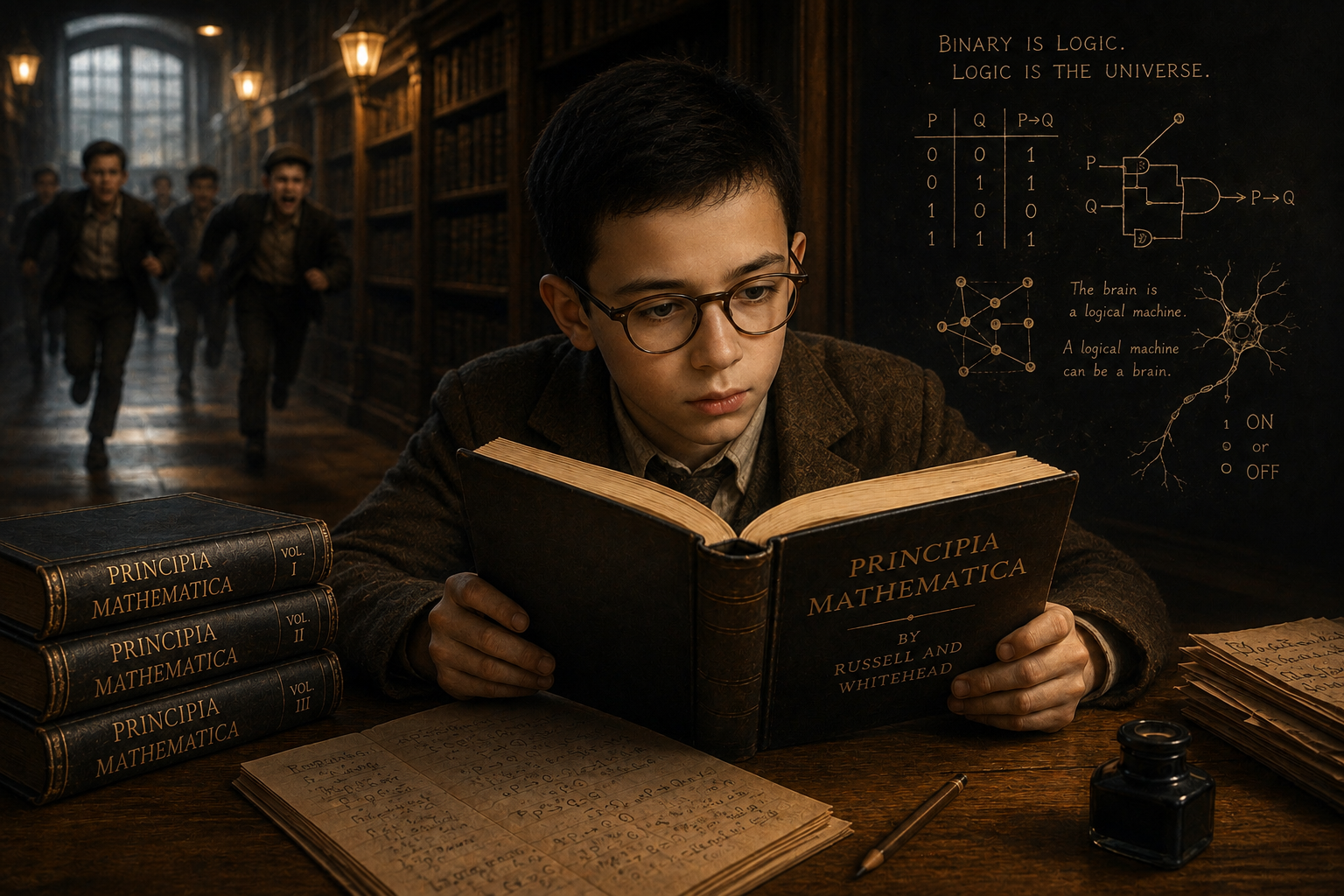
He felt like he couldn’t escape. They were hot on his heels. He could hear the laughter, taunting, and threats coming closer. His heart was pounding as he raced down the street.
As a twelve-year-old boy, Walter’s life in Detroit was far from ideal. He was eccentric, a polymath who loved learning. His uneducated parents and family never understood him. His peers derided and bullied him. In fact, they were after him now, ready to inflict some emotional and physical pain. Thankfully, Walter spotted a familiar refuge: the library. He bolted inside and buried himself in its book-lined catacombs. His breathing slowed, his heart stopped hammering. He kept looking around the corner and through the shelves to make sure he wasn’t followed. He was safe.
Standing there, relieved, Walter looked up and spotted a three-volume set of books that seemed to call to him: Principia Mathematica, by Bertrand Russell and Alfred North Whitehead. To take his mind off the chase, he began reading. He couldn’t stop. The mathematical logic it revealed suddenly unlocked the entire universe for him. Logic, the foundational unit of mathematics, didn’t just describe a model to represent the cosmos. It was the cosmos. To Walter, it unpacked everything. It would forever change his life, and the world, as we know it.
This weekend, I ran across the Walter Pitts story. As I read about a twelve-year-old boy running from bullies, I found myself transported back to my own childhood. I could almost feel the terror and anxiety. I remembered trying to run. Sometimes trying to stand my ground. Other times just looking for somewhere, anywhere, to disappear. Like a lot of kids, I found refuge in my own passions: a stack of library books, a soldering iron, a secondhand computer that took ten minutes just to boot. They were places where the rules made sense and curiosity mattered more than popularity.
Life has a remarkable way of redeeming difficult chapters. Sometimes the moments we’d gladly erase become the moments that quietly redirect our future. The story of Walter Pitts was familiar to me in that way. But what surprised me was what happened next. Walter’s newly acquired knowledge unlocked more than just his understanding, it unlocked new connections. He wrote to the author, Bertrand Russell, and explained errors he had found in the work. Russell was impressed and invited him to Cambridge University as a graduate student. Of course, Walter couldn’t attend, he was only twelve years old, after all, but the seed had been planted.
At fifteen, Walter ran away from home and made his way to Chicago. There, as a teenager hanging around the University of Chicago, he met a young medical student named Jerome Lettvin, and the two became close friends. It was Lettvin who introduced him to Warren McCulloch, a neurophysiologist obsessed with finding the relationship between the brain and the mind. McCulloch, recognizing something rare in the homeless teenager in front of him, invited Walter to live with him and his family.
Over a kitchen table in Chicago, Warren and Walter started working on a crazy idea: that neurons in the brain were simple signal processors that either fire or they don’t. On or off, like switches. Walter unlocked the mystery Warren had been seeking. He saw this binary behavior and postulated that a network of binary switches could compute any logical function that exists. The brain was a logical machine. And if that were true, then a logical machine could be a brain.
Warren and Walter eventually published a paper, “A Logical Calculus of the Ideas Immanent in Nervous Activity.” It received almost no attention. That is, until another polymath, John von Neumann, happened to read it. It gave him a key piece of the puzzle he’d been chasing, and it shaped his design for the first modern computer. The von Neumann architecture was born.
In his entire report laying out that architecture, von Neumann cited only one paper. That’s right, the one written at a kitchen table by a neurologist and a teenage runaway. Over a decade later, Frank Rosenblatt would cite the same paper as he built the perceptron, the first machine that could learn from examples. Later came backpropagation, the algorithm that lets networks of neurons adjust their own weights through training, a foundational technique for deep learning and the generative AI revolution we’re living through today.
The boy who escaped bullies by hiding in a library ended up changing the world. It’s easy to believe history is changed by billion-dollar investments, famous inventors, or grand master plans. Sometimes it is. But sometimes it changes because someone opens one more book. Asks one more question. Writes one more line of code. Builds one more prototype. Encourages one more teammate.
Most of those moments don’t feel historic. They feel ordinary. Walter’s story also reminded me of something else: the bullies didn’t change the world. Walter did. The hardship wasn’t the gift. His curiosity was. His resilience was. His decision to keep learning, despite everything life threw at him.
As we continue building the future of AI together, we’ll review designs, debate ideas, fix bugs, encourage one another, run experiments, and ship features. Most of those things will seem small. We probably won’t know which one matters most. Neither did Walter. He simply opened a book.
It makes me wonder… What seemingly ordinary thing are we working on today that someone, years from now, might look back on as the beginning of something extraordinary?