The J Storm

My first job was on a farm in Oklahoma. Hard work, and in the summer, brutally hot. But when you’re moving hay or driving the tractor, you get a lot of time to watch the sky and think. I never got as good as the other hands at calling the weather, but after a while I started to feel it. A gut instinct forms. I think it’s going to rain tomorrow.

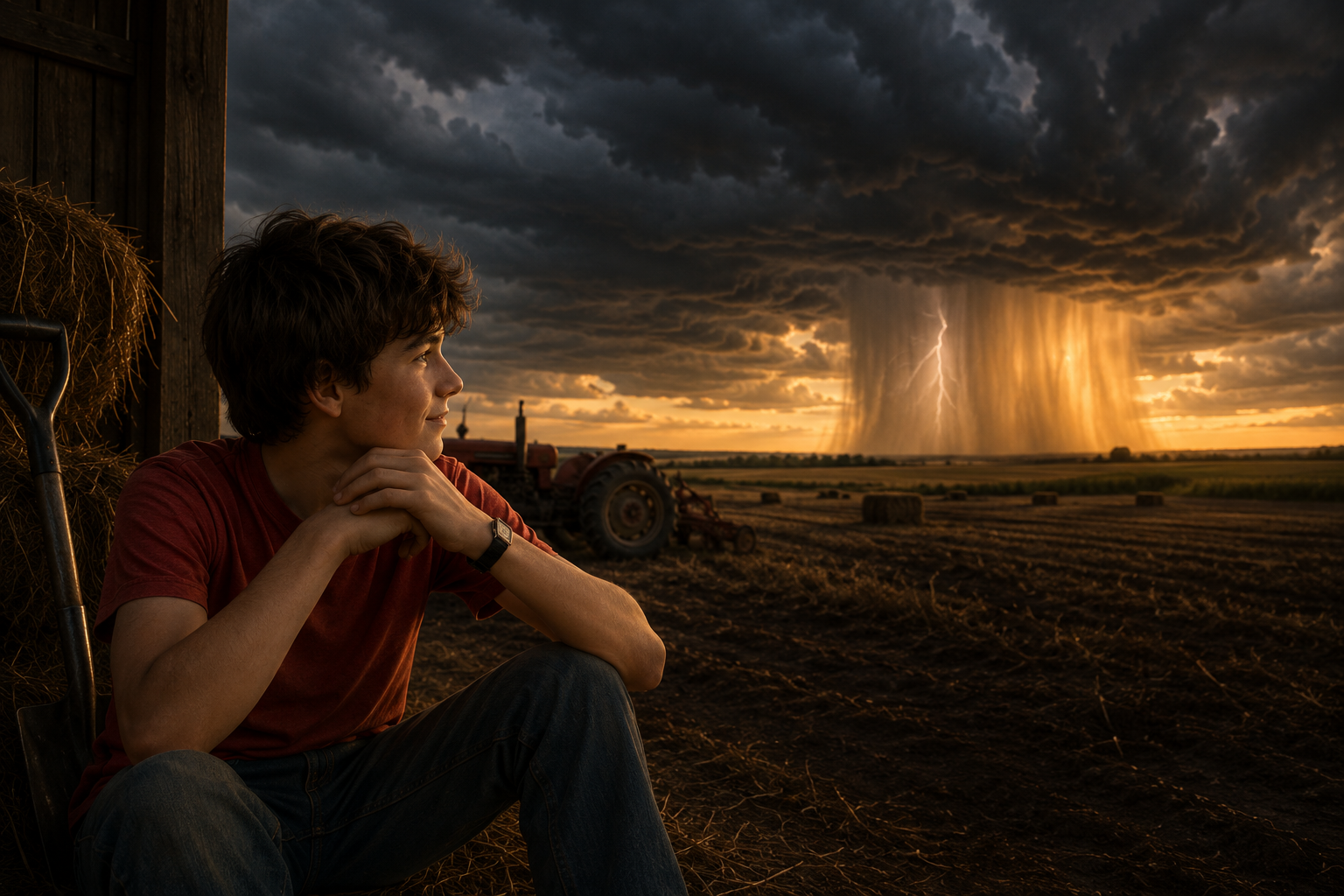
I remember one particularly hot, dry summer. We were standing in the shade when dark clouds began to gather on the horizon. The landowner, a farmer named Calvin, was anxious. A dry winter and a dry spring had put his whole livelihood at risk. Our spirits lifted as the wind picked up. The air grew heavy with moisture. A shadow swept across the fields.

Then, without warning, everything went still. Our hearts sank. The wind stopped. The land went quiet. Maybe there’d be no rain after all.

But stillness isn’t emptiness. Above those fields, forces we couldn’t see were still moving, gathering, reorganizing. The storm was growing, a silent, hidden surge. Then the wind returned. The sky changed, the clouds began to churn, and what had been invisible became unmistakable. Down came the rain, sheets of it, with earth-shaking thunder. The lightning and the downpour sent us running for cover. We were laughing, soaked, and breathing in that smell of life pouring out of the sky.

It strikes me that technology, companies, and whole industries live through moments like that during a transformation. Visible output slows. Progress looks stalled. The numbers hint that momentum is gone. But beneath the surface, a storm is building. People are learning new skills, workflows are bending around new tools, and new capabilities are forming that our current scoreboards simply can’t detect yet.

What looks like a pause is often the preparation for a storm of unprecedented power and productivity.

There’s a name for this: the Productivity J-Curve. Technologies like AI don’t deliver their full value on their own. They demand investment first, in new processes, products, business models, org structures, and above all, people.

Just as Calvin couldn’t see every force gathering above his fields, we won’t see every detail or timeline of what’s coming. But we shouldn’t just wait for the curve to turn. We should be building the things that turn it. Yes, there’s uncertainty. There will be failures and learning along the way. That’s not a bug. That’s the point.

Walt said it best: “We keep moving forward, opening new doors and doing new things, because we’re curious, and curiosity keeps leading us down new paths.” That curiosity is the fuel that bends the curve. It powers the expeditions that carry us past the horizon, to the land of tomorrow.

Watch the sky. Get ready. The rain is coming.

The Walter Pitts Story

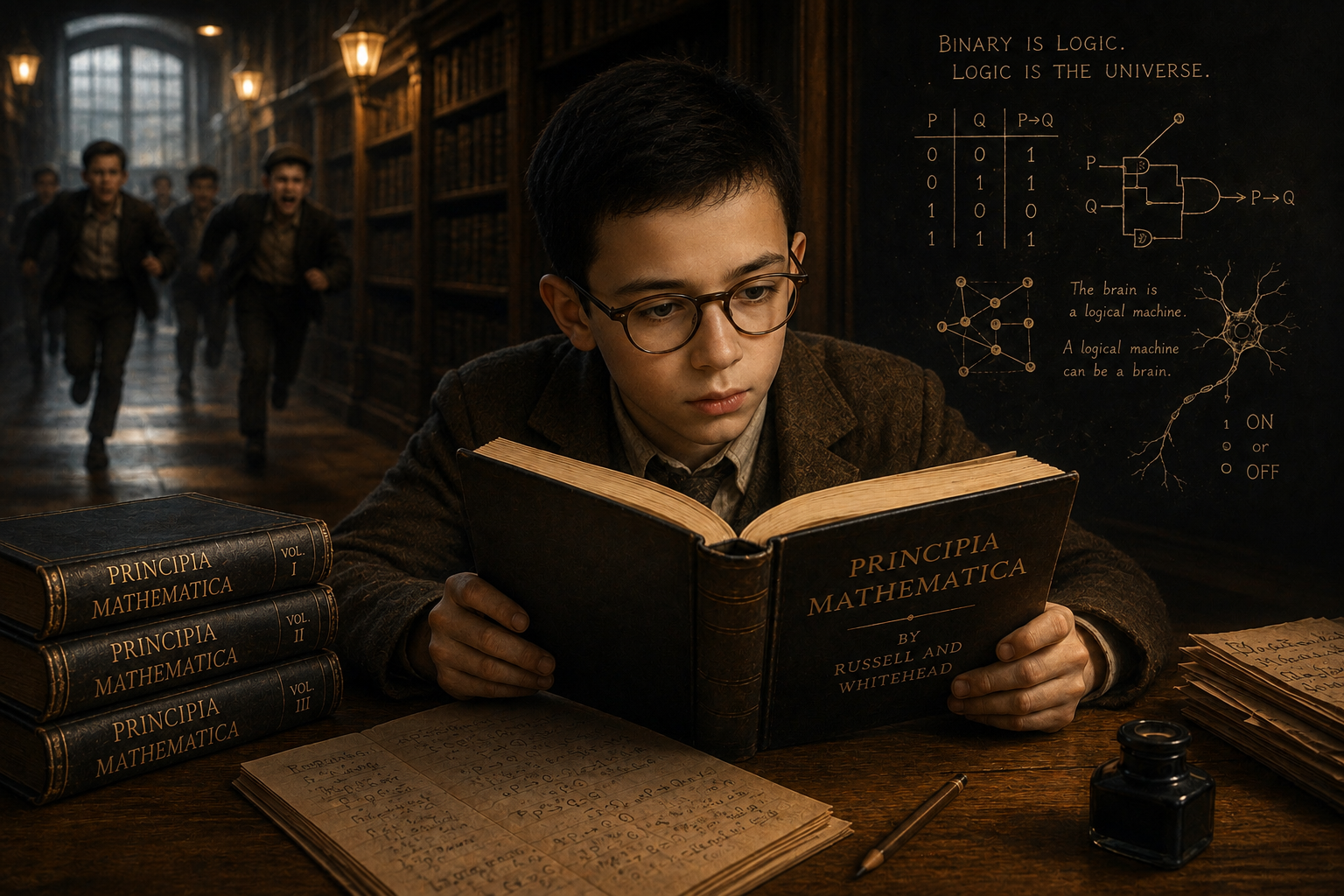
He felt like he couldn’t escape. They were hot on his heels. He could hear the laughter, taunting, and threats coming closer. His heart was pounding as he raced down the street.

As a twelve-year-old boy, Walter’s life in Detroit was far from ideal. He was eccentric, a polymath who loved learning. His uneducated parents and family never understood him. His peers derided and bullied him. In fact, they were after him now, ready to inflict some emotional and physical pain. Thankfully, Walter spotted a familiar refuge: the library. He bolted inside and buried himself in its book-lined catacombs. His breathing slowed, his heart stopped hammering. He kept looking around the corner and through the shelves to make sure he wasn’t followed. He was safe.

Standing there, relieved, Walter looked up and spotted a three-volume set of books that seemed to call to him: Principia Mathematica, by Bertrand Russell and Alfred North Whitehead. To take his mind off the chase, he began reading. He couldn’t stop. The mathematical logic it revealed suddenly unlocked the entire universe for him. Logic, the foundational unit of mathematics, didn’t just describe a model to represent the cosmos. It was the cosmos. To Walter, it unpacked everything. It would forever change his life, and the world, as we know it.

This weekend, I ran across the Walter Pitts story. As I read about a twelve-year-old boy running from bullies, I found myself transported back to my own childhood. I could almost feel the terror and anxiety. I remembered trying to run. Sometimes trying to stand my ground. Other times just looking for somewhere, anywhere, to disappear. Like a lot of kids, I found refuge in my own passions: a stack of library books, a soldering iron, a secondhand computer that took ten minutes just to boot. They were places where the rules made sense and curiosity mattered more than popularity.

Life has a remarkable way of redeeming difficult chapters. Sometimes the moments we’d gladly erase become the moments that quietly redirect our future. The story of Walter Pitts was familiar to me in that way. But what surprised me was what happened next. Walter’s newly acquired knowledge unlocked more than just his understanding, it unlocked new connections. He wrote to the author, Bertrand Russell, and explained errors he had found in the work. Russell was impressed and invited him to Cambridge University as a graduate student. Of course, Walter couldn’t attend, he was only twelve years old, after all, but the seed had been planted.

At fifteen, Walter ran away from home and made his way to Chicago. There, as a teenager hanging around the University of Chicago, he met a young medical student named Jerome Lettvin, and the two became close friends. It was Lettvin who introduced him to Warren McCulloch, a neurophysiologist obsessed with finding the relationship between the brain and the mind. McCulloch, recognizing something rare in the homeless teenager in front of him, invited Walter to live with him and his family.

Over a kitchen table in Chicago, Warren and Walter started working on a crazy idea: that neurons in the brain were simple signal processors that either fire or they don’t. On or off, like switches. Walter unlocked the mystery Warren had been seeking. He saw this binary behavior and postulated that a network of binary switches could compute any logical function that exists. The brain was a logical machine. And if that were true, then a logical machine could be a brain.

Warren and Walter eventually published a paper, “A Logical Calculus of the Ideas Immanent in Nervous Activity.” It received almost no attention. That is, until another polymath, John von Neumann, happened to read it. It gave him a key piece of the puzzle he’d been chasing, and it shaped his design for the first modern computer. The von Neumann architecture was born.

In his entire report laying out that architecture, von Neumann cited only one paper. That’s right, the one written at a kitchen table by a neurologist and a teenage runaway. Over a decade later, Frank Rosenblatt would cite the same paper as he built the perceptron, the first machine that could learn from examples. Later came backpropagation, the algorithm that lets networks of neurons adjust their own weights through training, a foundational technique for deep learning and the generative AI revolution we’re living through today.

The boy who escaped bullies by hiding in a library ended up changing the world. It’s easy to believe history is changed by billion-dollar investments, famous inventors, or grand master plans. Sometimes it is. But sometimes it changes because someone opens one more book. Asks one more question. Writes one more line of code. Builds one more prototype. Encourages one more teammate.

Most of those moments don’t feel historic. They feel ordinary. Walter’s story also reminded me of something else: the bullies didn’t change the world. Walter did. The hardship wasn’t the gift. His curiosity was. His resilience was. His decision to keep learning, despite everything life threw at him.

As we continue building the future of AI together, we’ll review designs, debate ideas, fix bugs, encourage one another, run experiments, and ship features. Most of those things will seem small. We probably won’t know which one matters most. Neither did Walter. He simply opened a book.

It makes me wonder… What seemingly ordinary thing are we working on today that someone, years from now, might look back on as the beginning of something extraordinary?

Be a Rosita

I spent the past few months postponing a rose problem. We have a beautiful red rose bush in our back yard. We call her Rosita. Every year, Rosita, very uncharacteristic of her name, puts on a huge blooming show starting in the spring and culminating with a dazzling display the first week of July. Normally, by this time of year, the buds have exploded into gigantic, softball-sized clouds of red with a fragrance so delightful you can smell it all over the yard. But this year’s July display was disappointing. Her show was like one of those $39.95 fireworks kits you buy at the roadside stand that promise a Disneyland spectacular but deliver a pipsqueak pop and a two-second flash in the sky. You know what I mean.

Anyway, I knew something was wrong. This weekend I decided to find the cause. Turns out, Rosita had an infection. A string of ivy had made its way onto her branches, and despite her sharp thorny defenses, she was being strangled by this invasive parasite. Dead branches lay in the wake of this rose-choking assassin. After a careful chat with Rosita, we all agreed: surgery was required.

Thorn-proof gloves on. Pruning shears in hand. I went to work extracting the invader. Carefully and deliberately, I cut away the dusty dead branches and spiraling vines. Rosita’s home would be free of these life-sucking vampires. A few hours later (yes, I’m quite slow), the operation was complete. Rosita was free again to thrive. I held my breath, wondering if it was too late. But just a few days later, roses began to appear again. New sprouting branches. New leaves. New life. That’s right, Rosita was back! Her red blooms were exploding with their usual charm.

This weekend I sat outside for a moment, enjoying the display Rosita was putting on for us, and thinking about the lesson I’d just learned. Things can enter our lives that slowly erode our ability to do what we do best. The parasites grow, slowly but surely sucking the life right out of our efforts. They can even create dead weight that keeps us from growing in new directions.

If you’re like me, you might have procrastinated a bit too much. Now the ivy is everywhere. But it’s not too late! Put on the gloves. Grab the pruning shears and go to work. Trim out what’s sapping the life out of you: the useless busywork, the habitual process that seems healthy but is actually a lie. No roses bloom from ivy. Snip. Take your time. Find the toil, find the useless weight that burdens your day. Remove it. Clean it up. Set your schedule free so you can breathe, grow, and bloom.

Okay, I confess, this note today was probably more for me than for you. But maybe, somehow, it resonates with you too, or with someone you love. If so, share it.

Clean out the ivy. Be a Rosita. Go put on a show.

Storytelling

I arrived early. The room was set up with a matrix of round tables, set for lunch. Only two people were in the room. I wandered up to the front table, next to the stage. No name tags. It seemed like fair game, so I sat down.

Slowly the room began to fill up, and so did my table. We chatted about the conference and the AI topics that had been the signature theme through all the presentations. Lunch was delivered and the lights began to dim. On the stage, right in front of me, an announcer appeared. “Hi friends! We are delighted today to have a special guest join us to talk about The Power of Story: How Imagination Fuels Innovation. Please welcome, LeVar Burton.”

I watched LeVar walk on stage and sit just a few feet from where I was sitting. My mind raced with questions, about Reading Rainbow, about Star Trek, about Roots. I never got the chance to ask any of them. I didn’t need to. LeVar unpacked his life in a masterful, story-telling way, punctuating each point with incredible twists and turns.

According to Burton, storytelling is not a soft skill or an optional elective. It is the foundational technology of human civilization. Everything, every new innovation, every accomplishment, begins as an act of imagination. Nothing manifests in the physical world without first being imagined. Storytelling is our lingua franca, the universal shared language across ages, cultures, and people groups. Everyone understands and connects through stories. In the old days, storytelling was around a warm fire, casting light and shadows on the speakers. Today, it’s a new fire, a cool fire: glowing screens and digital systems we use to craft, transmit, and deliver stories. But in all of it, storytelling is key.

Are you a storyteller? I confess, as a kid, I was terrible at it. I’d do my best to give a narrative, or worse, try to tell a joke, and my stepdad would literally roll around on the ground laughing at how bad I was. That stung, but he was also quick to encourage me, and to teach me how to tell stories. He was brilliant at it. I embraced the lessons. I’d try again, sometimes a little better than the last, sometimes not. But I kept trying. Somewhere between his laughter and his lessons, I stopped being afraid of failing at it. Now I love to tell stories myself. Probably too much.

How do you tell a story? As in my example, the best way to improve is to practice. Keep telling stories. Take the feedback. Keep going. You’ll get the hang of it.

“Life, like walking, is a controlled fall. Take the step that is in front of you, and the next step will always reveal itself.” — LeVar Burton

Like learning any new skill, life gives us endless opportunities to fall. We might wish there were a magic button: press it, become an instant expert or artisan, but that isn’t how it works. It’s a series of trying, falling, failing, getting better, and trying again. Just like my own path to becoming a storyteller. The key is to keep trying: to place that foot of faith right out in front of you and keep walking.

Sometimes that means sitting at the front table, even if you don’t know you belong there. Sit down anyway. The story is about to begin.

Do you have a story? I know you do. Write it down if you haven’t already. Tell someone. Keep creating new ones. We are storytellers, after all. It defines us. It changes the world around us. It brings new color, flavor, and dimension to our lives. It even helps us imagine, and do, the impossible. 

Keep telling stories.